

Swiss Clinic
Menu
Swiss Medical

X-ray

Digital X-ray examinations for fast, targeted imaging diagnosis of bone, joint, spine, chest and other conditions.

Digital X-ray diagnostics

Fast imaging to assess the condition of your bones, joints and chest

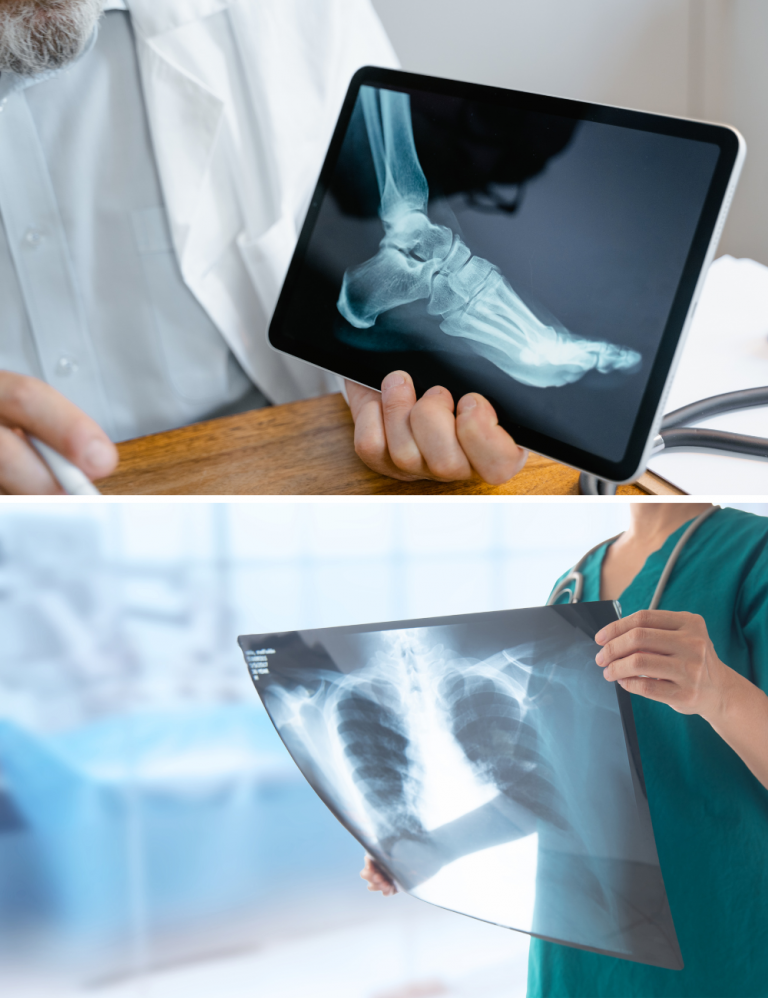
X-ray is one of the most commonly used imaging diagnostic methods. It shows bones particularly well, so it is often the first test chosen to evaluate injuries, fractures, and joint and spine changes. A chest X-ray can also be used to examine, among other things, the lungs, the chest and certain heart- and lung-related abnormalities.

Digital X-ray examinations at Swiss Clinic can be performed on many parts of the body and, when needed, from different angles. The images are followed by a radiology evaluation, and the results can help your treating physician refine the diagnosis and plan further testing or treatment.

Book by phone

Schedule an appointment quickly by speaking directly with our team:

+36 1 225 0566

Instant online booking

Don't want to wait? Book now and get immediate confirmation!

Book an appointment
Digital X-ray diagnostics and examination

What to know before your X-ray

Most standard X-rays do not require any special preparation. However, to ensure good image quality and radiation safety, it is important to share a few details in advance.

What should you keep in mind before you arrive?

  • Tell us if you may be pregnant: Because X-rays use ionizing radiation, if you are pregnant or could be pregnant, tell the technologist before the image is taken. In this case, the need for the exam is assessed individually.
  • Remove metal objects and jewelry: Jewelry, belts, metal buttons, zippers, eyeglasses or other metal objects can show up on the image, so they may need to be removed from the area being examined.
  • Referral and side to be examined: If your treating physician gave you an exam request, referral or outpatient form, bring it with you. It is important to know the exact body area and whether the right side, left side or both sides need to be examined.
  • Bring your previous images: If you have had an X-ray, CT or MRI of the same body area before, the earlier results can help with comparing them to the new image.

When might you need an X-ray?

An X-ray is most often needed on a physician's recommendation to evaluate a specific symptom or injury:

  • Suspected injury or fracture: If you have pain, swelling, deformity or difficulty bearing weight after a fall, a blow, a sports injury or another accident, an X-ray can help identify bone injuries.
  • Joint and extremity problems: If you have persistent knee, ankle, hip, shoulder, elbow, hand or foot pain, an X-ray can provide information about, among other things, structural changes in the bones and joints.
  • Spine problems: In certain cases of neck, upper back or lower back symptoms, an X-ray can be used to examine the alignment of the vertebrae and some bony and degenerative changes.
  • Chest and respiratory symptoms: A chest X-ray can help in evaluating a persistent cough, certain chest symptoms, suspected pneumonia or other justified cases.
  • Dental and oral surgery evaluation: Panoramic and other dental X-rays can be taken to plan dental, oral surgery or orthodontic treatment, among other purposes.

Available X-ray examinations

At Swiss Clinic, a variety of standard and specialized digital X-rays can be performed:

Extremity and joint X-ray

For hand, arm, shoulder, hip, knee, ankle, foot and other extremity problems, an X-ray is used primarily to examine the structure of the bones and joints.

Why choose Swiss Clinic?

An X-ray can be done quickly, but defining the right body area, imaging angle and clinical question is important for a truly useful diagnostic result. Swiss Clinic's digital radiology capabilities make it possible to perform a wide range of standard and specialized X-rays.

Book an X-ray appointment

Modern digital imaging

Digital X-ray technology enables fast imaging and a detailed radiology evaluation of the images.

Many body areas covered

Extremity, joint, spine, pelvis, chest and skull X-rays are available, along with several specialized views.

Images reviewed by a specialist

The radiology evaluation of your X-rays helps your treating physician determine the diagnosis and next steps in your care.

Further testing as needed

If an X-ray does not provide enough information, depending on your condition, an ultrasound, CT, MRI or other targeted test may be recommended.

How is an X-ray taken?

An X-ray uses ionizing radiation to create an image of the body's internal structures. Different tissues absorb radiation to different degrees, so bones, air-filled areas and soft tissues appear differently on the image.

During the exam, the body area being examined is positioned, standing or lying down, and the images are taken from one or more angles. The exposure itself is very brief, and it is important to stay still while it happens. For a chest X-ray, you may also be asked to hold your breath for a few seconds. The images are then reviewed by a radiologist.

Have you been asked to get an X-ray for an injury, a joint or spine problem, or do you need a chest or lung exam? Swiss Clinic offers a variety of digital X-rays that can help clarify the cause of your symptoms and plan further treatment.

Main areas of expertise and examination:

Bones and joints

  • Evaluation of fractures and bone injuries
  • Extremity and joint X-rays
  • Assessment of degenerative bone changes
  • Follow-up images as needed

Spine and pelvis

  • Cervical spine
  • Thoracic spine
  • Lumbar and lumbosacral spine
  • Pelvis and hip X-rays

Chest and other areas

  • Chest X-ray
  • Lung screening
  • Sinus and skull X-rays
  • Dental and jaw X-rays

Don't let your symptoms leave you with unanswered questions

Our experienced medical specialists and advanced diagnostic technology can help identify the underlying causes of your symptoms. Choose an appointment time that works best for you.

Frequently asked questions

The most common questions about digital X-ray diagnostics.

Most standard X-rays do not require any special preparation. It is a good idea to wear clothing that makes it easy to expose the body area being examined, and be prepared to remove jewelry or other metal objects from that area.

The X-ray itself is not painful. However, if you have an injury or significant musculoskeletal pain, positioning the affected area can be uncomfortable. If a movement causes severe pain or you cannot get into the requested position, let the technologist know.

During pregnancy, the need for an X-ray must be weighed especially carefully. If you are pregnant or could be pregnant, always tell us before the exam. If an X-ray is medically necessary, the way it is performed is determined by weighing the expected diagnostic benefit against the radiation exposure.

It depends on the body area being examined and the clinical question. Many bone and joint exams require two or more views from different angles, because not every abnormality can be properly assessed from a single image. Some exams may also call for specialized or comparison views.

A normal X-ray result does not rule out every musculoskeletal or soft tissue problem. Tendons, ligaments, muscles, cartilage and certain early changes are shown only to a limited extent, or not at all, on a standard X-ray. For persistent symptoms, your treating physician may therefore recommend an ultrasound, CT, MRI or another test.